
Home water filter or bottled water?
Compare the cost per gallon, the counter space, the upkeep, and the claims before you buy.
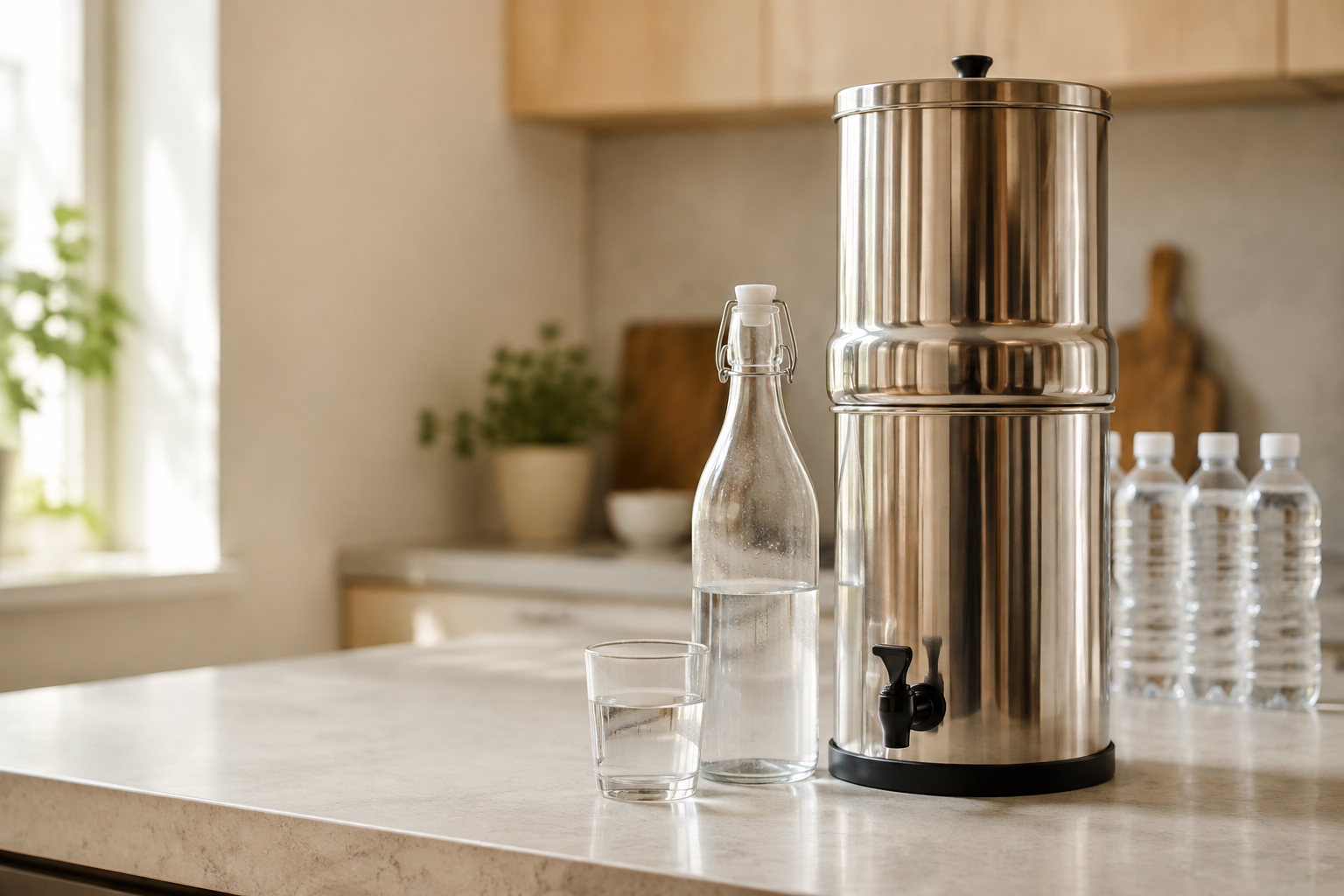
Bottled water solves an immediate problem. A home filter can solve the repeating one: buying, carrying, storing, and replacing the same volume week after week. The financial case can be strong—but only when the filter fits your water and you maintain it.
Refill the glass, not the shopping cart.
For a household that already trusts its tap-water source, filtering at the point of use can make daily drinking water more convenient and less expensive than repeatedly buying packaged water.
Lower potential cost
A durable housing and replaceable elements spread their purchase price across hundreds or thousands of gallons. The calculator below makes that comparison visible.
Less to carry and store
No cases in the trunk, gallon jugs in the pantry, or last-minute trip when the last bottle is empty.
Less single-use packaging
A refillable bottle and maintained filter can replace many individual bottles. The exact packaging avoided depends on what your household buys now.
Taste on tap
Some filters reduce chlorine taste and odor. Better-tasting tap water may make the reusable routine easier to keep.
The right filter depends on what needs filtering.
Read your public water system's annual quality report or test private-well water at least yearly. Then match the exact model and certification to the substance you want to reduce. Taste and appearance alone do not tell you whether water is safe.
NSF/ANSI 42 generally covers aesthetic effects such as taste and odor. Other standards address specific health-related reductions. “Tested to” a standard is not the same as a current product certification.
Clean the system and replace elements on schedule. Filters that are not maintained can lose performance and may support germ growth.
A countertop filter is not a universal answer for boil-water notices, floods, fuel, toxic chemicals, or radioactive contamination. Follow local health instructions.
Read the CDC guide to choosing a home water filter and verify certifications in the NSF listings.
Minimal setup, no plumbing, and a routine you can see.
Gravity-fed systems sit on the counter and work without electricity or a plumbing connection. Setup is usually limited to washing the chambers, installing and priming the elements, and filling the upper chamber. Ongoing maintenance is straightforward, but it is hands-on.
They are portable, renter-friendly and easy to place into service. There is no installation appointment, and the stainless housings used by many brands can last through multiple sets of replacement elements.
Someone must monitor the water level and refill the upper chamber. Filling it while the lower chamber is still full can cause an overflow, so the lower level should be checked first.
The elements need periodic cleaning according to their instructions as sediment and buildup slow the flow. The chambers and spigot also need routine washing. Hard water can leave mineral scale that may require occasional descaling with the manufacturer-approved method.
Typical system-price ranges are estimates, not live Amazon prices. Use the Amazon link on each card to check the current price.
Big Berkey 2.25-gallon system
The Big Berkey is the familiar choice for a reason: it holds enough for everyday drinking and cooking without feeling enormous on the counter. The stainless chambers are straightforward to clean, and there is no plumbing to figure out. Its familiar stainless-steel design also makes it an easy fit for households that want a straightforward countertop system.
- Best for
- Households that want a roomy, established gravity system and do not mind a hands-on refill routine.
- Keep in mind
- The 2.25-gallon capacity may require more frequent refilling in a larger household, and the chambers need occasional cleaning.
Culligan MaxClear gravity system
This is the gravity system that makes the easiest case on paper. It has the same simple fill-and-dispense routine as other stainless countertop filters, but Culligan backs the exact MaxClear element with unusually broad independent certification. That takes some guesswork out of shopping if lead, total PFAS or microplastics are the reason for buying a filter in the first place.
- Best for
- Readers who want a no-plumbing gravity filter with clearly documented health-related claims.
- Keep in mind
- Culligan recommends replacing the MaxClear filter about every six months, although actual filter life may vary based on water quality and household use.
British Berkefeld Doulton W9361137 · 3.17 gallon
The larger 3.17-gallon chamber is the practical advantage here. It needs fewer refills than the typical 2.25-gallon system, which is helpful when several people are filling bottles throughout the day. The ceramic candles can also be gently cleaned when buildup slows the flow. Just pay close attention to the candle supplied with the system, because Doulton sells several versions and their verified claims are not interchangeable.
- Best for
- Larger households that want more countertop capacity and cleanable ceramic elements.
- Keep in mind
- The filled unit is heavy, and the exact replacement candle must match the system and the claims you are relying on.
BOROUX Legacy
BOROUX has the most polished feel of this group. The three-gallon stainless body looks at home in a finished kitchen, the spigot and chambers carry a lifetime warranty, and two filters can serve a household of up to four when the unit is filled daily. It is a good fit for someone who wants the Berkey-style format with a newer, more finished design.
- Best for
- Shoppers who care about stainless construction, counter appearance and a generous three-gallon reservoir.
- Keep in mind
- Like any gravity system, it needs regular refilling and occasional cleaning. Check the price and availability of its specific replacement filters when comparing the long-term cost.
Filtered water on demand, without watching a reservoir.
An under-sink filter connects to the cold-water line and delivers filtered water whenever the faucet is opened. Direct-connect models use the existing faucet; multi-stage and reverse-osmosis systems often add a dedicated drinking-water faucet. Reverse osmosis also uses additional incoming water to flush concentrated contaminants to the drain. The amount varies by model and water conditions, so use the exact system’s efficiency ratio when estimating municipal water and sewer costs.
There is nothing to carry across the kitchen, refill or monitor. The system stays out of sight and supplies filtered water on demand for drinking and cooking.
Some direct-connect systems are manageable DIY projects. A dedicated faucet, drain connection or reverse-osmosis tank involves more steps and may require a plumber, especially when the counter must be drilled or the existing valves are difficult to work with.
Replacement schedules vary widely—not every system lasts one or two years. Some cartridges are rated for about six months, while higher-capacity models may last a year or longer. Multi-stage and reverse-osmosis systems can require several filters on different schedules, making genuine replacements a meaningful ongoing expense.
Typical system-price ranges are estimates, not live Amazon prices. Use the Amazon link on each card to check the current price.
Waterdrop WD-15UA
The WD-15UA is the uncomplicated budget pick. It connects to the cold-water line, keeps the existing faucet and takes up very little cabinet space. That makes it appealing for renters or anyone who mainly wants better-tasting municipal water without adding a second faucet. Its low price does come with a narrower job description: this is not the model to choose when certified lead or PFAS reduction is the priority.
- Best for
- Treated municipal water where chlorine taste and odor are the main complaints.
- Keep in mind
- Waterdrop's 19,000-gallon figure is a manufacturer-rated capacity. Actual life varies, and the certification does not cover lead or PFAS reduction.
APEC ROES-PH75X · 6-stage alkaline RO
This is the option for someone who wants reverse osmosis but does not love the flat taste RO water can have. After the membrane removes dissolved solids, the sixth stage adds calcium back and raises the pH. The package also includes an extra pre-filter set, which softens the first year of maintenance costs. It is a conventional tank system, though, so expect it to claim a noticeable amount of cabinet space.
- Best for
- Households that want RO filtration with calcium remineralization and do not mind a storage tank.
- Keep in mind
- Installation includes a dedicated faucet and drain connection. RO also produces reject water, and several cartridges follow different replacement schedules.
APEC CS-2500P
The CS-2500P is a nice middle ground between a basic taste filter and a full reverse-osmosis installation. It feeds the existing faucet at up to 1.67 gallons per minute, so there is no separate drinking tap and less waiting to fill a pot. The scale inhibitor is a useful extra in hard-water areas, although it is not a softener and will not remove dissolved minerals the way RO does.
- Best for
- Homes that want a fast, space-saving direct-connect filter with chlorine, lead and scale-reduction claims.
- Keep in mind
- This is a direct-connect carbon filter rather than a reverse-osmosis system, so it keeps the natural minerals in the water and does not lower total dissolved solids.
Brondell Coral UC300
The Coral UC300 is the most balanced under-sink choice on this list. Three stages handle sediment, chlorine and a long list of health-related contaminants, while the twist-and-seal cartridges keep the annual filter change from becoming a plumbing project. The included faucet has a simple filter-change light, and the system is slim enough to mount against the cabinet wall instead of taking over the whole space.
- Best for
- Someone who wants broad certified reduction claims without moving up to reverse osmosis.
- Keep in mind
- It requires a dedicated faucet and all three UF-35 cartridges are replaced as a set. Rated flow is 0.5 gallon per minute.
iSpring RCC7-BN
The RCC7-BN is the workhorse RO choice. It uses a traditional five-stage layout and storage tank rather than a compact proprietary cartridge, which means more parts under the sink but also widely available replacement media. The brushed-nickel faucet is a small detail that makes the package easier to match with common kitchen fixtures. Owner reviews consistently praise the water taste, instructions and support, which is reassuring for a system with a more involved installation.
- Best for
- DIY-minded households that want a well-reviewed, conventional RO system with strong exact-model certification.
- Keep in mind
- It needs a dedicated faucet, drain connection and room for the tank. RO removes dissolved minerals and sends a portion of incoming water to the drain.
Make the reusable option the easy option.
A filter saves the trip to the bottled-water aisle, but a bottle or tumbler is what makes that water convenient away from the kitchen. These are mostly budget-oriented multipacks from lesser-known brands rather than premium-name bottles. That is intentional: families, teams and larger households can often get a lower cost per bottle or tumbler by buying a set instead of purchasing each one separately. Amazon prices change, so divide the current price by the number of items in the pack before deciding which set offers the better value.
Typical pack-price ranges are estimates, not live Amazon prices. Options, coupons and sellers can change the total.
20-ounce stainless-steel tumblers with lids
This six-pack makes sense when the goal is to replace disposable cups for the whole household at once. Twenty ounces is roomy enough for everyday water without making the cup feel oversized, and the lids are helpful at a desk, in the backyard or anywhere an open glass is easy to knock over.
- Best for
- Families, guests and shared workspaces that need several matching cups.
- Keep in mind
- A lidded tumbler is better suited to upright use than being tossed into a bag. Check the listing’s care instructions before putting the cups or lids in the dishwasher.
Volhoply 32-ounce insulated bottles with straw and spout lids
The useful feature here is choice: a straw lid is convenient for sipping throughout the day, while a spout lid is simpler when you want a quicker drink. The 32-ounce size also cuts down on trips back to the filter, and buying four together can be more practical than assembling a household set one bottle at a time.
- Best for
- Adults and older kids who want a larger bottle and more than one lid style.
- Keep in mind
- A 32-ounce bottle gets noticeably heavier when full and may not fit every cup holder or backpack pocket.
Neihepal 20-ounce insulated bottles
These are the compact option in the group. A 20-ounce bottle is easier to carry, easier for smaller hands to manage and less awkward on a crowded desk. The four-pack is also practical when everyone needs a dedicated bottle instead of sharing one or two larger containers.
- Best for
- School bags, shorter outings and households that prefer lighter bottles.
- Keep in mind
- The smaller capacity means more frequent refills, especially in hot weather or during exercise.
Neihepal 24-ounce insulated bottles
The 24-ounce size lands in a comfortable middle ground: more water than a standard small bottle, without the bulk of the largest options. A matching four-pack works well for a household that wants bottles substantial enough for daily use but still easy to carry around.
- Best for
- Everyday commutes, school and moderate water drinkers.
- Keep in mind
- Confirm the included lid style and bottle dimensions on Amazon if cup-holder fit is important.
VEGOND 40-ounce insulated bottles with straw and spout lids
This is the high-capacity choice for people who would rather fill once and keep moving. Forty ounces is useful for long work shifts, sports and day trips, while the straw and spout lid options let different people choose how they prefer to drink.
- Best for
- Busy days, outdoor activities and anyone who regularly finishes a smaller bottle too quickly.
- Keep in mind
- Forty ounces of water weighs about two and a half pounds before counting the bottle, so this size can feel bulky when full.
Volhoply 24-ounce insulated bottles with straws
A six-pack is useful when the aim is to make reusable water the default for a larger family, team or group. The 24-ounce capacity is large enough for a useful amount of filtered water while remaining more manageable than a 32- or 40-ounce bottle. The bulk format also makes it easier to outfit everyone in one purchase and compare the per-bottle cost.
- Best for
- Larger households, group activities and keeping spare bottles ready.
- Keep in mind
- Straw lids have more small parts than a basic cap, so they need regular, thorough cleaning.
One filter cycle can represent years of water.
Compare purchased water with a home filter.
The system price covers the filter that comes with it. Choose whether the product lists its filter life in gallons or months, then enter that one replacement limit.
The comparison uses the exact gallon volume, so the total may represent part of a case.
- Cost per gallon
- —
- Water used
- —
- Replacement sets purchased
- —
- Filtered water used
- —
Estimate only. If the product lists both a gallon capacity and a time limit, use whichever replacement limit you expect to reach first. Actual life can be shorter because of water quality and use. Fixed utility fees, cleaning, accessories, taxes, shipping and early replacement are excluded.
Filtered water wins when the routine is safe, simple, and actually used.
If your tap water is suitable for the filter you choose, the cost per gallon may be dramatically lower than bottled water. But the useful comparison is not a headline capacity by itself. It is the cost of the exact system, the exact replacement element, the gallons your household uses, and the maintenance you will realistically do.